Tuesday, December 2, 2014

How Do Essential Oils Work? The Power of Scent

Essential oils are the naturally occurring aromatic chemical compounds found in plants, flowers, roots, bark and seeds. You’ve most likely experienced the aromatic qualities of many essential oils if you’ve ever enjoyed the fragrance of a flower garden, or freshly chopped herbs. But essential oils are much more than a fragrance. They actually serve to protect the plants from disease (strengthening the plants immune system) and even aid in pollination, oxygenation and regeneration. 

Essential oils are considered the ‘life blood’ of the plant, and for good reason. Essential oils are literally a plant's natural medicine against bacteria, viruses, and diseases that attack its cells. These extracts from plants are 50 to 70 times more powerful than herbs.

It's important to realize our bodies and plants have very similar building blocks. So, when we take these essential oils into our bodies they are in a familiar environment and they go to work on our behalf just as they would for the plant, killing bacteria, inhibiting virus reproduction, cleansing toxins, destroying parasites, oxygenating our cells and boosting our immune system. 

Today we will be exploring the benefits of using essential oils aromatically - the most widely recognized benefit of essential oils. Don't forget to read about the topical ad internal benefits of essential oils.


Aromatic Benefits of Essential Oils

Essential oils, by nature, have a strong odor associated with them. Besides smelling nice, they can clean the air, destroying both odors and toxins. A whiff of lavender releases feel-good hormones and makes us happier, and a hint of eucalyptus improves alertness. Smells can impact many things in our lives, from dreams and emotions, to stress, pain, concentration, memory and romance. 

How Does It Work?

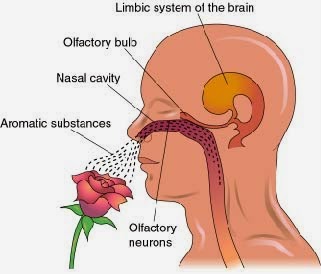
When essential oils are inhaled, they enter the body via the olfactory system, which has a direct connection to the limbic system in the front of the brain. The limbic system is known as the primitive brain and it encircles the top of the brain stem and forms a border linking cortical and midbrain areas with lower centers that control automatic, internal body functions. 
It is associated with feelings such as hunger, thirst, anger, sadness, sexual arousal and pleasure. It is also associated with creativity, learning and memory. This is one of the reasons why so often something that we smell will trigger a memory or remind us of something or someone. (Source: Aroma-Pure)

Dreams

Experiencing floral smells before sleep, such as lavender and chamomile, can lead to more positive dreams. In research at the Sleep Disorders Centre of the University of Heidelberg, men and women were exposed to either the smell of flowers or hydrogen sulphide, or to no smell at all. Results show that the emotional content of subsequent dreams was linked to the smell. Those who had the floral smell had significantly more pleasant dreams than those who had no smell and the people exposed to the sulphur smell had the most negative dreams. Researchers are now looking at whether pleasant smells could reduce the risk of nightmares. 

Insomnia and Stress

Clinical trials have shown that the smell of lavender can help in insomnia, anxiety, stress, and post-operative pain, according to a report from Maryland University. "There is now scientific evidence to suggest that aromatherapy with lavender may slow the activity of the nervous system, improve sleep quality, promote relaxation, and lift mood in people suffering from sleep disorders," say the researchers. A study at Tubingen University in Germany shows that vanilla fragrance has a calming effect, while a Thailand study showed the smell from roses reduces both breathing rate and blood pressure.

Concentration

Peppermint and lavender have been found to aid in concentration. Spraying the scent of lavender during factory tea breaks in Japan has been shown to improve post-break production. Athletes who sniffed peppermint ran faster and had better concentration than those who had no smell.

Memory

Smells are very powerful triggers of specific memories, and are used in therapy to help recover lost memories. Research at Toronto University shows that memories triggered by smells tend to be clearer, more intense and more emotional. One theory is that this is because the part of the brain that processes smell has direct links with parts that are involved in emotion and memory.

Blood Sugar Levels

In a study carried out at Cardiff University, insulin was injected into healthy men once a day for four days and their blood glucose levels fell. Each time they were injected, they were exposed to a smell, but on the fifth day the men were just given the smell... and their blood glucose still fell.

Studies can be cited from the original source at saga.co.uk

doTERRA Wholesale Account: Step-By-Step Sign-up

Are you ready to...

  • Learn how to use essential oils?
  • Provide natural health options for your family?
  • Take control of your health naturally?
  • Be more self-reliant with your health?
  • Soothe your children quickly and effectively?
Getting wholesale prices on therapeutic grade essential oils has never been easier. You can get started quickly & easily online by following the steps below:

Opening a Wholesale Account

  1. Click this link to take you to the simple registration page. 
  2. Begin by picking your country and language.
  3. Once you’ve selected your country, select “Wholesale Prices”
  4. Fill out your name, address, billing address, shipping address and remaining contact info.(Don’t’ be alarmed when doTERRA asks you to list your Tax ID number or SSN. This is for tax purposes only. You are opening a Wholesale Account giving you the ability to generate income. If you make over $600/year, you will receive a 1099 form in the mail, as is required by law. I promise you doTERRA will never share this info with anyone!)
  5. The “Enroller ID” and “Sponsor ID” boxes should already be filled in for you but if not, enter 854405 in both boxes.
  6. Select your time zone and your own virtual office password.
  7. Agree to the basic Terms and Conditions and your Virtual Office User Agreement. Click “Continue”.
  8. Select your initial order, meaning, your $35 Introductory Packet plus the first products you’d like to choose a la carte by typing in the names of the oils or products. OR – pick an ENROLLMENT KIT and your wholesale fee is waived!

Benefits of Wholesale Account

  • 25% discount off of retail prices
  • Earn 10%- 30% back on your qualifying orders when you participate in the Loyalty Rewards Program (optional but highly recommended)
  • Enrollment fee is only $35 - or FREE if you purchase an enrollment kit.
  • Low $25 renewal fee. dōTERRA will send you a free bottle of peppermint upon renewal.
  • Special members-only promotions.
  • Online account access to manage your orders.
  • Products ship directly from dōTERRA.
  • Access to an amazing business opportunity (not required but highly recommended).
  • Access to private team Facebook pages (This is an amazing resource!)
  • Essential Oil Education
  • Exclusive Business Training with a Generous Compensation Plan
You can enjoy wholesale membership without any strings attached – No requirements to buy or sell. I like to compare it to a Costco or Sam’s Club membership.

Questions? Shoot me a message using the contact form or leave a comment below. 

Feel Good & Be Well
XO

Wednesday, November 26, 2014

Ayurveda and Essential Oils

Ayurveda is a natural healing philosophy with roots in Indian culture, based on early literature from the Vedic period. Over the centuries, ayurvedic practitioners have developed medicinal procedures based on this philosophy.

Ayurveda is based on 5 elements including Ether, Earth, Water, Fire, and Air that compose both the human body and the world around us. These elements are grouped together to create three Doshas. Doshas are important because when they are in balance, the body will be healthy. When they are unbalanced, the body will be out of balance and less healthy.

Ayurvedic theory suggests that each human possesses a unique combination of the doshas and that they define the person’s character and attributes. Think of it as the grandfather philosophy of all of the personality type studies in modern times.


The Pitta Dosha is Fire and Water. The Kapha Dosha is Earth and Ether. The Vata Dosha is Ether and Air. A person can be strong in any one dosha but have attributes of all doshas.

Want to discover your prominent dosha? Take this Dosha Quiz by The Chopra Center.

Once you know your dosha, you can begin to help keep yourself in balance through following the aryuvedic principles for proper eating, exercise, meditation, and essential oils.

doTERRA’s certified pure therapeutic grade oils can be used to help balance the Doshas:

Pitta Dosha: Associated with the elements of fire and water, pittas are passionate and intense. They have a joyful disposition but they are subject to anger, jealousy, and short tempers when unbalanced. There is often a need to cool off and clarity the mind.

If you are a Pitta type, you may need calming and cooling oils to keep the fire element balanced. Oils such as Sandalwood, Ylang Ylang, and Lavender would be great for cooling and calming. Oils such as Grapefruit, Sweet Orange, and Lavender would be good for a refreshing massage. doTERRA’s Citrus Bliss Blend and Serenity Blend would be perfect for the Pitta type. As well as Lavender single oil. Find your essential oils here.


Vata Dosha: Associated with the elements of ether and air, vata types are quick thinking, thin, and fast moving. They are active and creative and have a natural ability to communicate. When unbalanced, vatas can have high anxiety and fast moving emotions.

If you are the Vata type, you may need oils that help to ground, balance, and warm your dosha. Oils such as basil, cypress, frankincense, geranium, and rosewood will help the vata stay balanced. doTERRA’s Whisper Blend and Balance Blend as well as Geranium single oil would be a good fit for Vata types. Add these oils to your routine.


Kapha Dosha: Associated with the elements of earth and water, kappa types are patient, forgiving and slow to anger. They are loving and become easily attached. When they are unbalanced, kaphas can become lazy or stubborn as well as greedy.

If you are the Kapha type, you may need oils to help help lift and stimulate. Oils such as rosemary, eucalyptus, marjoram, melissa, lemon, peppermint would help you stay balanced. doTERRA has two great blends for the Kapha type. Elevation Blend to lift you up and Breathe Blend to clear the air passages. Grapefruit single oil would also be an excellent to help with balance. All three of these oils can be found here.


Get wholesale prices on doTERRA essential oils and other natural wellness products including supplements, weight management, and natural beauty products.

Original content found at Essential Yoga Program. 

Monday, November 17, 2014

Everyday Yoga

Since I discovered the healing power of yoga some 10 years ago, I can't imagine a single day of my life without it. We've all seen the hashtag #yogaeverydamnday which has become quite the trend for fancy photos on Instagram. But it's more than that. Everyday yoga is about staying present, maintaining balance throughout the day, and continually riding a wave of calm energy as you pass through life. 

I do practice #yogaeverydamnday because I have to for myself, my family, and for the world around me. I came to a point where no matter how badly I wanted to do yoga, I just couldn’t find the time for it. With two young kids who never seem to want to sleep at the same time, it’s hard enough to find time for a shower let alone time to practice yoga.

I was frustrated. I was sore & stiff. I was even more frustrated because I was sore and stiff.
So I came up with a way to incorporate some highly beneficial yoga poses into everyday life – especially those things that can seem really mundane. These 5-minute yoga exercises are a combination of Hatha movements, Yin yoga holds, and a little Face yoga to keep you looking fresh.

How much time do you have?
Sometimes it really is only five minutes. As Buddha says, “meditate for 20 minutes every day. If you don’t have 20 minutes, then meditate for one hour.” I highly doubt that Buddha had to chase two toddlers around.

We live in a time-crunched society that glorifies being “busy” at all times. As much as we collectively need to slow down, all too often it just isn’t an option. We have families to care for, demanding jobs to keep up with, places to be, people to see...

Instead of making up for a stressful week with an hour-long class that finally fits in your schedule once a week, practice 5-minutes at a time every single day and watch as the transformation unfolds. You will find yourself more relaxed, more alert & present.

What is Yoga?
Literally translated, the word yoga means “union.” The exercises done in yoga paired with rhythmic & conscious breathing help to bridge the gap between the mind & the body. Yoga means something different to everyone. Sometimes I begin my classes by asking students if they could put into one word what they want out of their yoga and share it with the class. You might be surprised at the varying answers. Some want to relax, others want to gain strength, many are looking to find relief from pain. The one thing every one answer has in common is that underneath it all, it’s about feeling better.

The good thing about yoga is that it really is for everyone. You cannot be too old or too young, too big or too small for yoga. Yoga is inclusive to all beings.

Yoga is becoming more accessible by the day. If your town doesn’t have a yoga studio, you can take classes online 24 hours a day. There’s hot yoga, snowga (yes, yoga in the snow), paddleboard yoga, aerial yoga, kids yoga, yoga for seniors, Star Wars yoga… when I say there’s a yoga for everyone I mean everyone.

Quality over Quantity

Just because you don’t have a full hour to dedicate to a yoga class doesn’t mean that you can’t benefit from yoga. Five minutes of deep stretches or rhythmic movements paired with energizing or relaxed breathing can sometimes be more beneficial than a crowded room full of sweaty bodies. 

Follow me this week as I take you through some Everyday Yoga exercises accessible to ALL PEOPLE. 

Sunday, November 16, 2014

Everyday Yoga: Setting Your Intention

Sometimes when you practice yoga, you may come to your practice with a personal intention or goal. Many teachers like to offer a theme in their class to inspire an intention -- gratitude, strength, acceptance, etc. Other times, your intention becomes clear after you’ve taken a few breaths.  

If an intention does not come to you right away, ask yourself these questions:
  • What brought me to my mat today?
  • What would I like to invite into my practice or my life?
  • What holds me back or weighs me down in life?
Based on that intention, you may want to come up with a mantra to remind you of this intention. A mantra is a short phrase, similar to an affirmation, that reminds you what to look for and where.

Here are a few sample mantras that you can use during your 5-minute yoga sequences:

  • I deserve to live a healthy & happy life
  • Out with the heavy & in with the light
  • This is moment is just for me
  • I am happy, I am well, I am peaceful (credit goes to Bhante Sujatha for this mantra)
If an intention or mantra don't come to you, don't worry. A good intention to fall back on is to remain present in your practice.

Allow yourself time to pause throughout your practice and remind yourself of your intention behind your actions or recite your mantra. Close your class by sealing your intention with your hands together at your heart in Anjali mudra.

Monday, October 6, 2014

How to Deal with an Overly Critical Person

Twas a wise little rabbit that once said, "If you don't have anything nice to say, don't say anything at all."

While that would be a much more pleasant world to live in, it's simply not the case.

Criticism can be a good thing when it's delivered in the right way and with the right context. How can we ever expect to grow if we are not honest with one another? Constructive criticism is delivered in a positive manner by offering valid opinions about the work of others. This kind of criticism encourages others to grow into a better version of themselves. Many of the great people we know in the world became that way because of constructive criticism.

Then there's the other kind of criticism. The kind of criticism that simply points out all of the negative aspects about a person or situation without offering any advice on improvement. While this criticism can be situation-specific, you may find that the people that deliver this criticism quite often do so in all aspects of their lives. An overly critical person is often hostile, withdrawn, and pessimistic.

Overly critical people often need help and guidance, so simply shutting them out wouldn't be the most fair approach. Here's a few ways to deal with an overly critical person.

Art by Matthew Hoffman


Try not to take it personally.
Often times a critical person is pointing out their own flaws or shortcomings, not yours. Avoid identifying yourself with the words of a critic. A person who criticizes will do so anyway, no matter what your actions or intentions may be. Your value does not decrease by someone else's words.

Hear the words, not the delivery.
Criticism is often paired with anger, frustration, and delivered at an increased volume. What is the point that is trying to be conveyed? Can it be addressed in a calm manner? Remember that the person who loses their temper has lost control of the situation. Stay in control, stay calm and try to listen to the words.

Respond with kindness.
How people treat other people is a reflection of how they feel about themselves. An overly critical person is likely battling many insecurities. Don't let them pull you into their storm, pull them into your peace. Change the subject by pointing out strengths rather than magnifying weaknesses.

Just because you listen doesn't mean you have to accept.
Some people just need to be heard. I feel that to be a basic human right. All too often, we listen only to respond and attempt to fix problems when we haven't been recruited to do so. It is not necessary to react to everything you hear. Simply lending an ear can make a big difference.

Avoid the situation.
When all else fails, remove yourself from the negativity. It's hard to live a positive life with a negative mind -- even when it's not your mind that is negative. Unfortunately, you cannot help a person who doesn't want to help themselves.

Sunday, October 5, 2014

Face Yoga for Jaw Tension

Did you know that your jaw muscles are the strongest in your body for their size? These small but mighty muscles have the ability to chomp a human finger clean off.

The jaw muscles are comprised of four major muscles: the masseter, the temporalis, and the lateral & medial pterygoid.

A recent Chicago Dental Society survey reported that 1 out of every 4 Americans tense their jaw muscles excessively. This number was an all-time high and believed to be the result of increased stress in our daily lives.

If you're like 25% of the population, including me, you might find yourself tightening your jaw muscles without even noticing. Often when we are faced with a difficult task we tense -- whether it occurs at home or in the office, or even in our yoga practice during a particularly long hold or challenging pose. Excessive jaw clenching and tooth grinding can also cause headaches and tension in other areas of the body.

So let's put a stop to this, shall we?

It begins now, with our own awareness. It continues the rest of the day, and tomorrow, and the day after that. It is a constant reminder to care for yourself and remain aware of what's happening inside of your body.

5 Minute Face Yoga for Jaw Tension 


  • Begin with 5 round of Lion's Breath (Inhale through the nose; Open the mouth & eyes wide as you stick your tongue out as far as it goes and exhale out the mouth, somewhat resembling the roar of a lion)
  • Remove the tongue from the roof of the mouth
  • Relax the very base of the tongue
  • Keep the lips together, but slowly begin to separate the teeth
  • Imagining that the chin has a pencil tip in the center, begin to draw figure-8's with your lower jaw. Do this for about a minute, reversing directions halfway through
  • Keep the teeth separated, now curl the lips over the teeth and open the mouth as wide as possible, extending outward into the cheeks. Try not to let any other facial muscles tense. Hold for 5 breaths, then release
  • From a tall supported spine, begin to circle your head clockwise with a loose neck 5 times, then 5 times in the opposite direction
  • Come to stillness with a tall spine through the crown of the head
  • Silently (or loudly) mouth your vowels (AEIOU) ten times
  • Take 5 more rounds of Lion's Breath and relax the face
Repeat this sequence as many times as necessary to feel relief.

Another effective stretch is allowing the head to fall backward and the mouth to open as wide as possible. I like to use Supported Fish Pose for this stretch. Be careful not to place any discomfort on the neck or crunch the cervical spine with this one.

Tension is who think you should be. Relaxation is who you are. (Chinese proverb)